
The Love Tank’s
DIY HRT Roadmap
No matter where you are in your DIY HRT journey, we know it can be difficult to find clear information and support. We’ve got you covered:
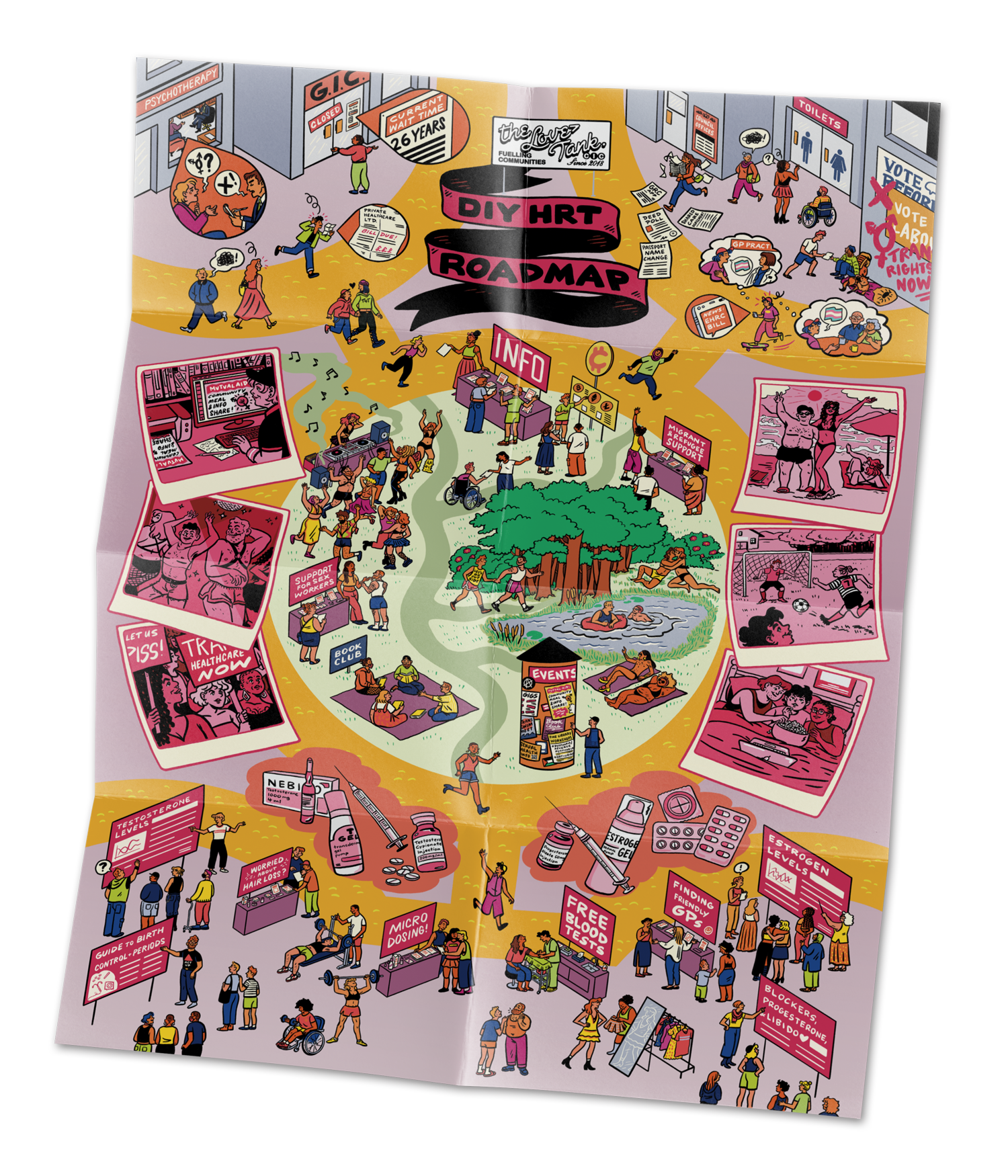
The DIY HRT Roadmap is here to help you find your way!
The roadmap is for people who are already DIYing (whether it’s been a month, a year, or twenty years!), as well as people who are thinking about starting.
It answers common questions and provides information for many different stages of the DIY journey.
This guide outlines everything you need to know about DIY HRT, including:
Getting started, ways to access, using masculinising hormones, using feminising hormones, tips on navigating society, and finding community.
Thank you to the trans people who shared their wisdom and experience with us at every point of the creation of this guide. Thank you also to the hundreds of people working tirelessly every day to support trans DIYers – including those who have created the resources and lifelines signposted throughout this page.
What is the DIY HRT Roadmap?
DIYing means using HRT - hormone replacement therapy - without a prescription or away from a clinic. We know that people choose to DIY for lots of reasons: because NHS Gender Identity Clinic (GIC) waiting lists are very long, private healthcare is too expensive, there are no suitable services nearby, they have experienced barriers to care, or they want more control over their HRT journey.
Without support from a doctor or clinic, it can be harder to access reliable information. For example, people may not know what physical changes to expect, which types of HRT are available, how to use them, or where to get medical supplies such as needles.
This guide provides information about accessing HRT, using it more safely, legal rights, costs and payment methods, and the effects HRT can have on the body. It includes information for transfeminine, transmasculine, as well as non-binary people and also covers practical topics, such as navigating everyday life while DIYing.
Each section includes links to resources, forums, guides, and community discussions. We’ve chosen these carefully to provide additional information and support. They were also chosen because they are reliable and easy to access. They are there to help you continue your own research if you need more information.
The questions, answers, and illustrations in this guide were created by and for trans communities, including through a series of DIY cafe events. It was researched and written by trans and non-binary people from The Love Tank and beyond.
We know this roadmap doesn’t include every useful resource. It’s a living document that can be updated over time. If you think a resource is missing, or would like your own resource to be included, please email us at hello@thelovetank.info with the subject line ROADMAP.
A Note on Language
We know that the language that describes our bodies can be fraught, difficult and highly personal. Throughout this roadmap, we have tried to use language that is respectful, inclusive, and empowering for all trans people. However, in some sections - mainly when explaining health conditions or some medical information - we use medical or anatomical terms for certain body parts. This might not be the language that you use to describe your own or other people’s bodies.
We’ve done this - sparingly! - to make sure the information is clear and easy to understand. It is also to help you learn the words that doctors and other healthcare professionals may use, so you can talk about your health needs and ask for support if you have any concerns.
TABLE OF CONTENTS
📍
🗺️
TABLE OF CONTENTS 📍 🗺️
GETTING STARTED
1. What is DIY HRT?
Some transgender and gender-nonconforming people choose to take hormones to feminise or masculinise their bodies independently, without getting a prescription from a doctor or involving the medical system. For example, they might take hormones they've been given by a friend, bought online, or imported from another country. This is known as DIY HRT, or do-it- yourself hormone replacement therapy.
While exact numbers are hard to come by, we know that DIY HRT is very common. According to one estimate, as many as a third of trans people in the UK might take DIY HRT at some point during their transition.
See also: https://en.wikipedia.org/wiki/DIY_transgender_hormone_therapy
2. Why do people take DIY HRT?
Reasons for taking DIY HRT vary, but for many people they include:
Extremely long NHS waiting lists for trans healthcare
Not being able to afford private care
Psychiatric service gatekeeping, or fear of discrimination
Wanting more control, autonomy, or dignity
Some of these reasons are outlined further by Anne Health here.
3. Is it legal to DIY?
In the UK, it is legal to own testosterone, oestradiol, most antiandrogens, and most anabolic steroids for personal use. This means that it is usually legal to take DIY HRT.
It’s illegal to supply or sell hormones, even if you’re only sharing them with a friend. In the case of masculinising hormones like testosterone, it can also be illegal for someone buying them to have them posted in the mail, or delivered by courier. Some more information about the law regarding masculinising hormones can also be found here.
4. Is it expensive to DIY?
DIY HRT can be very cheap. Injectable hormones often cost less than £100 yearly, while blood tests cost roughly £30 - £120 each when not provided for free by an NHS service. Other forms of hormones might be more expensive.
Although costs vary, one reason many people DIY is that it tends to be much cheaper than private care.
5. Is DIY HRT safe? How do I make it safer?
Hormones are widely used, relatively safe medications that generally have very few interactions. There are some risks to taking DIY HRT though including:
Using unsafe injection techniques
Taking too much or too little for a long time
Using mislabeled, contaminated, or inappropriate medicines
Most of these risks can be minimised by taking harm reduction steps. These include: knowing how to inject safety, if you are injecting; using clean/sterile supplies; getting regular blood tests to monitor your health; and getting good information so you know what you’re doing.
One of the best ways to stay safe is to engage with other trans people and communities on DIY HRT, either in person or online. Examples of this might include peer-led needle and syringe provision programmes like THNX, online discussion groups like r/transdiy, or local mutual aid groups. Often, these communities will be able to tell you things about staying safe that you might not already know.
6. What if I have a long-term health condition?
Hormones have very few interactions with other medicines, and are safe to use for most people with long-term health conditions, like people living with HIV.
If you are taking oestrogen, the NHS has resources available on other health conditions and their potential interactions. You can find those here.
7. Can I DIY forever?
For many people, DIY HRT is a temporary stop-gap measure until they're able to access NHS care.
That said, some people do DIY for decades, or even choose to DIY forever.
8. What effects does DIY HRT have on your body?
In general, the use of feminising hormones will lead to effects such as softening of the skin, breast development, decreased muscle mass and strength, and decreased sex drive. Masculinising hormones lead to increased muscle mass and strength, increased sex drive, facial hair growth, and eventual lowering of the voice.
A full overview of the effects of hormones can be found below.
Feminising hormones:
https://transfemscience.org/articles/transfem-intro/#effects-and-timeline
Masculinising hormones:
https://transcare.ucsf.edu/article/information-testosterone-hormone-therapy
9. Are the effects of DIY HRT reversible?
Many of the effects of DIY HRT are reversible, but some are permanent or long-lasting.
If you are taking testosterone or other masculinising hormones, then effects like clitoral growth (often known as bottom growth), facial hair growth, voice changes and male-pattern baldness are not totally reversible.
If you are taking oestrogen or other feminising hormones, then some breast growth, and possibly reduced or absent fertility are not totally reversible.
10. Can I DIY while receiving NHS- or private trans healthcare?
Many people do DIY while receiving NHS or private care, for example by:
Taking higher or different doses of hormones than prescribed
Supplementing a prescription with medications that a provider refuses to prescribe, like progesterone, finasteride, or Viagra
Often, doctors will ask you to stop if they learn you are doing this, and discontinue your prescription if you don't. However, because a doctor usually won’t know you are doing this unless you tell them, it’s still incredibly common in practice.
11. Can I access NHS or private trans care after DIYing?
Yes. Most trans healthcare providers know that many people DIY before they are seen, and encourage switching to formal care.
Usually, they will have a discussion with you about what you are taking, and either offer to take over your prescription, or prescribe something comparable to what you're taking.
12. Can I DIY if I am a migrant or refugee?
As a migrant or refugee, you might not be able to access all NHS care, or stable housing.
This can make DIYing more difficult, but at the same time, these can be reasons in themselves for choosing to DIY. In practice, many migrants and refugees do take DIY HRT.
13. Can I DIY as a nonbinary person?
Many nonbinary people DIY, for example because:
They experience more gatekeeping in the formal healthcare system. Nonbinary people might be required to get more extensive psychiatric approval than binary trans people before being provided with care, and often report negative experiences, such as doctors not taking them seriously
There are fewer medical treatments available in the formal healthcare system than there are when DIYing. Medicines like nandrolone (for masculinisation without hair loss), raloxifene (for feminisation without breast growth), among others, are often quite experimental, and as such, not available from healthcare providers
Further resources:
14. Can someone DIY if they are under 18?
If you are a parent or carer of a young trans person, or under 18 yourself, you might be interested in DIYing. Access to care for under-18s has been severely restricted in the UK in recent years, and as a result, there are several things you should know if this applies to you.
Puberty blockers (also known as GnRH analogues) are currently banned in the UK: although no prosecutions have taken place that we know of, it is technically a crime to supply them, prescribe them, or dispense them. Because of their unavailability, most young trans people instead take oestradiol or testosterone, either through private providers or DIY.
The following private providers provide services for people under 18:
It's important to know that GPs and local authorities are often advised to initiate safeguarding procedures if they learn that someone under 18 is taking hormones or puberty blockers (even with a prescription), which has led to referrals to social services. An example of this guidance for GPs can be found here.
The Good Law Project has published a large resource for parents and young people on navigating referrals to social services.
In practice, many trans people under 18 do DIY, and large parts of the guidance around this constitutes a legal grey area. We've published a detailed guide around access to puberty suppressing hormones.
15. Is it too late for me to start DIYing?
Although much older people can be at a higher risk of problems like blood clots, it is possible to take DIY HRT at any age.
Many trans people regret not starting sooner.
Further resources:
HOW DO I ACCESS…
16. Where can I buy safe DIY hormones?
17. How do I access blood tests?
18. How do I access fertility preservation?
19. How do I switch to private care?
20. How do I switch to NHS care?
21. Can my GP help me with DIY HRT?
22. How do bridging prescriptions work?
23. How does shared care with private prescribers work?
24. How do I access trans-friendly therapy?
25. How do I get a diagnosis or psychologist's letter if I need one?
26. Can I access NHS-funded laser, electrolysis, or voice training while DIYing?
16. Where can I buy safe DIY hormones?
There are several community websites that list and vet vendors selling DIY hormones. In general, a vendor is more likely to be safe if you find reasonable numbers of other trans people using them.
Communities dedicated to discussing DIY HRT, like the TransDIY subreddit, can often provide more detailed information.
17. How do I access blood tests?
If you’re DIYing, you might want to access blood testing.
Lots of DIYers use blood tests as a way to monitor their hormones (to see if their hormones are reaching the desired level in their body), as well as to monitor the potential impact of hormones on their overall health (for instance, liver health or cholesterol levels).
Your NHS GP may be willing to provide free monitoring blood tests if you tell them you're DIYing, and ask them to do so. This is sometimes seen as a harm reduction measure. Some people choose to switch to a different GP to access this. You can find community-maintained lists of trans friendly GPs who might be comfortable providing this service here and here.
In London, both 56 Dean Street and CliniQ provide free NHS blood tests for people who DIY. They are widely used clinics, and usually involve simply making an appointment for testing. Waiting lists can be long, so it often makes sense to book several weeks in advance.
If these options don't work for you, there are many private providers who will provide blood tests, usually at a cost of roughly £30 - £120. Popular examples include the trans-led Sapphic Bison, Medichecks, Randox Health, and Blue Horizon. Depending on the provider, options often include postal fingerprick test kits, or blood draws in partnered pharmacies and clinics.
18. How do I access fertility preservation?
Because hormones can make you infertile, it usually makes sense to access fertility preservation before starting hormones if you’re interested in having children in the future.
There are different options depending on whether you produce sperm or eggs.
TransActual maintain an extensive guide to accessing fertility preservation:
19. How do I switch to private care?
You don't need a referral to access a private provider, meaning you can simply sign up on their website (even if you are already DIYing).
Usually, they will require an assessment with a psychiatrist or psychologist, followed by the possibility of appointments with, for example, an endocrinologist (hormone specialist) afterwards.
See also:
20. How do I switch to NHS care?
In order to switch to NHS care when DIYing, you will first need your GP to refer you to a gender identity clinic (GIC).
From there, it is likely to be several years before you are seen. Once you're seen, there will usually be an initial assessment with a psychiatrist or psychologist, followed by the possibility of appointments with, for example, an endocrinologist (hormone specialist) afterwards.
See also:
21. Can my GP help me with DIY HRT?
Your NHS GP can help in a number of ways if they are willing.
A GP can:
Give you a bridging prescription. A bridging prescription is a temporary prescription for hormones while you wait to be seen by a gender identity clinic. For some people, this can be an alternative to DIYing. You can find a guide about accessing bridging prescriptions here.
Give you blood tests to monitor your hormone levels and overall health
Refer you to other specialists: for example, a psychologist if you have mental health problems
Unfortunately, GPs are under a lot of pressure not to provide bridging prescriptions and blood tests. For that reason, many people who DIY end up switching GPs to access these services, if they are available at all. You can find community-maintained lists of trans friendly GPs who might be comfortable providing these services here and here.
See also:
22. How do bridging prescriptions work?
Your NHS GP can choose to prescribe hormones while you wait to be seen by a gender identity clinic (GIC). This is called a bridging prescription.
For some people, this can be an alternative to DIYing. An explanation can be found in our Little Backpocket Guide To Bridging Prescriptions and on Anne Health’s website.
See also:
23. How does shared care with private prescribers work?
When you have a private prescription for hormones, your NHS GP can provide blood testing and prescriptions free of charge on the advice of your private prescriber.
If your GP is willing to do this, it can save a lot of money. A detailed explanation is available here.
See also:
24. How do I access trans-friendly therapy?
Some trans people find that they benefit from therapy outside of accessing hormones or surgery - for example to work through feelings on gender, trauma, depression, or anxiety.
There are various therapy providers who are explicitly trans friendly, and specialise in the issues a trans person might face. You can find them below:
In London, there is also a specialised LGBTQ+ drug, alcohol & chemsex support service: https://londonfriend.org.uk/antidote/
25. How do I get a diagnosis or psychologist's letter if I need one?
Many people who DIY find that at some point in their transition, they need a formal diagnosis, or a letter from a psychologist. Usually, these are needed in order to access surgery, or to access hormones privately, for example.
Information on getting a diagnosis or psychologist's letter can be found here.
26. Can I access NHS-funded laser, electrolysis, or voice training while DIYing?
Most people who take DIY hormones are also interested in other feminising or masculinising procedures, like hair removal or voice training.
On the NHS, these services can usually only be accessed with a referral from a gender identity clinic. As such, it can take many years before they become accessible.
For this reason, most trans people pursue laser, electrolysis, or voice training from private providers, such as beauty clinics and independent (paid) voice and language therapists.
See also:
27. Can I access surgery while DIYing?
Surgery on the NHS requires a referral from a gender identity clinic, but most private surgeons accept patients who take DIY HRT.
Depending on whether you're getting surgery in the UK or abroad, requirements for psychiatric assessments, letters, maximum BMI, and so on may vary, but in practice, many people who DIY can and do access surgery.
See also:
28. How do I use crypto currency?
Because of payment processor restrictions, many sellers of DIY hormones exclusively accept payment through (legal) crypto currencies, such as bitcoin.
Many people who DIY find it useful to know how to use crypto currency at some point in their transition. Some guides can be found below:
https://cryptpad.fr/pad/#/2/pad/view/CNxHRUJ3esv6X8b0dy5MecY9sijzzWbEuIEnxm9qs74/embed/
USING MASCULINISING HORMONES
29. What forms of masculinising hormones are there?
30. Can I use masculinising and feminising hormones at the same time?
31. Are injections better than other formulations of hormones?
32. What about herbal hormone supplements?
33. What are the health risks of masculinising hormones?
34. How much should I be taking?
35. Which blood tests should I get?
36. What should my hormone levels be?
37. What happens if my dose is too low or too high?
39. What if I can't access blood tests?
40. What if I’m afraid of getting a blood test?
41. What if I have to go off hormones for a while?
42. How do I manage my hairline or hair loss on masculinising hormones?
43. Are there other ways of stimulating beard growth?
44. Will hormones help me build muscles?
45. Will HRT cause bottom growth?
46. Can hormones cause vaginal atrophy?
47. Why do I still get monthly bleeding on hormones? Can I prevent this?
48. Can I still get pregnant on masculinising hormones?
49. How can I increase or decrease my libido?
50. What happens if I smoke, drink, or take drugs while on hormones?
51. What if I decide hormones aren't for me and I want to stop or detransition?
52. Will HRT relieve dysphoria?
53. What happens if I get reverse dysphoria from taking masculinising hormones?
29. What forms of masculinising hormones are there?
Most people take testosterone, of which there are two main forms:
Gels that are applied daily to the skin
Injections that are taken on schedules ranging from every week to every 3 months
Some people take other forms of hormones that have similar effects to testosterone, such as anabolic steroids. Anabolic steroids are often taken by mouth or by injection. One example of this is nandrolone, which works similarly to testosterone. Testosterone and anabolic steroids are often discussed in bodybuilding communities like r/steroids , comprehensive online resources like r/steroids/wiki, as well as on community discussion forums about sourcing steroids, like eroids.com. More harm reduction information on steroids can also be found here.
30. Can I use masculinising and feminising hormones at the same time?
Yes. It's very common for people who take masculinising hormones to also take oestrogen and progesterone, for example:
As birth control, since it's still possible to become pregnant while taking masculinising hormones
As a cream to treat the vaginal dryness masculinising hormones can sometimes cause
Some people also choose to take both purely as a way of affirming their gender and shaping their body. Often, the overall effect of this is masculinising, because testosterone tends to have more powerful effects, but it's very possible to do.
31. Are injections better than other formulations of hormones?
Injections can have some advantages to some people, especially when DIYing:
They are often easier to find. Grey market testosterone injectables are widely available, while testosterone gel is relatively rare, although it is often still distributed within major transmasculine communities
They are often more economical: an injectable vial can last much longer, cost less, and have significantly less bulk than a comparable amount of gel
Some people prefer not to take gel every day, or aren't in circumstances where they're able to (for example, because of unstable housing). Taking an injection weekly, every few weeks, or even every few months, can be more feasible
That said, injections and other forms of hormones, such as gels, are equally effective when dosed comparably. In practice, injections are often taken at a slightly higher dose than gels, which is one reason they can seem more effective to some people.
32. What about herbal hormone supplements?
Several companies market different formulations of herbal hormone supplements for transitioning. Some people find these tempting because they are easy to get. Unfortunately, herbal hormone supplements do not work, and can be dangerous.
See also:
33. What are the health risks of masculinising hormones?
The health risks of masculinising hormones can include problems with cholesterol, sleep apnea, and the body producing too many red blood cells.
Most of these risks can be avoided or managed by getting regular blood tests.
See also:
34. How much should I be taking?
Finding the right dose requires blood testing. That said, to get an idea, most people take:
Short-acting testosterone injectables such as Sustanon: 50-100 mg once/week or 100-250 mg every 2-4 weeks
Long-acting testosterone injectables (Nebido): 750-1000 mg every 10 - 14 weeks
Gels: 25 - 100 mg every day
If you’re taking much more than this, then you might be taking too much. Taking much higher doses is not always more effective, but does carry health risks such as your body producing dangerously too many red blood cells. Additionally, in some cases, it can cause problems because the body can counterintuitively convert excess amounts of testosterone back to oestrogen (this is called aromatisation).
If you’re taking much less than this, then you might be microdosing (see: What is microdosing?). This is fine if you’re intentionally choosing it: for example, doses as low as 10 mg of gel are sometimes taken as a microdose. However, this should be an informed choice on your part.
See also: https://en.wikipedia.org/wiki/Masculinizing_hormone_therapy
35. Which blood tests should I get?
Blood tests help you monitor your hormone levels and the potential impact of hormones on your health.
It's common for different doctors and clinics to recommend slightly varying blood tests. In order of importance, you probably want to take the following tests at minimum:
Testosterone: to measure your T levels
Full blood count: to make sure hormones aren’t making your body produce too many red blood cells, which can create a risk of blood clots
Liver function tests ("ALT"): to make sure testosterone isn't negatively affecting your liver
HBA1c: to monitor your blood sugar
Cholesterol: because masculinising hormones can cause it to worsen
Most people start out with blood tests every 3 months (or after any dose change), slowly easing up to once a year or less.
36. What should my hormone levels be?
In most cases, all your blood test results should be roughly in line with those of the cisgender male range. This includes red blood cell counts, cholesterol, and so on.
According to the Endocrine Society, cisgender male testosterone levels are approximately 10 - 35 nmol/L. If you're microdosing, or taking other masculinising hormones like nandrolone, your levels might differ. If you’re taking injectable testosterone, your target levels might also vary.
See also: https://doi.org/10.1210/jc.2017-01658
37. What happens if my dose is too low or too high?
Taking too many masculinising hormones can be dangerous and lead to health problems with long-term use, like your body producing too many red blood cells.
Additionally, in some cases, it can cause problems because the body can counterintuitively convert excess amounts of testosterone back to oestrogen.
Taking a low dose of hormones is generally safe, but can lead to much slower and less wide-ranging changes, which is important to know if you're not deliberately microdosing.
38. What is microdosing?
Some people intentionally take lower doses of masculinising hormones, because they want the changes to their body to be slower and more subtle. This is commonly called microdosing.
See also:
39. What if I can't access blood tests?
Blood tests are used in hormone therapy for two reasons:
To make sure you’re getting an effective dose: without being able to calibrate your dose, you might not get the effects of hormones that you want to an optimal degree
To make sure you are generally in good health, and hormones aren’t having a preventable, harmful effect on your body (for example: making sure you’re not producing too many red blood cells).
It isn’t ideal if you can’t access blood tests at all through any route - although some people do go for long times without blood testing (for instance, if they are travelling for a long time, can’t afford to, or can’t get an appointment) without major consequences. Hormones are still relatively safe medications, and lifesaving for many trans people, so the benefits of using hormones without accessing blood testing often do outweigh the costs. However, the best way to stay safe if you are not sure you will be able to get your bloods tested is to make sure you use average dosages that aren’t too high or too low for most people, and work towards accessing blood tests when you can in the future.
See also:
40. What if I’m afraid of getting a blood test?
Being afraid of blood testing or needles is incredibly common among both cis and trans people alike. It is still very important to get blood tests if you’re able to to make sure you are taking an effective dose of hormones and are in generally good health.
There are some things that might help if you struggle with blood tests:
Telling the person drawing your blood ahead of time can be helpful, so that they can help you through the process
If fasting is not needed for your blood test, then having plenty to eat and drink beforehand can help make it easier to find your veins, and get it over with quicker
Several different breathing and relaxation exercises are helpful for some people
Local anaesthetic creams, like Emla cream, applied to the skin can be helpful in reducing pain at injection sites for some people
Some resources can be found below:
https://www.guysandstthomas.nhs.uk/health-information/needle-phobia-and-overcoming-your-fear
https://www.nuffieldhealth.com/article/4-ways-to-stay-calm-during-a-blood-test
https://www.reddit.com/r/MtF/comments/rgr56v/anyone_else_afraid_of_blood_tests/
https://lloydspharmacy.com/products/emla-numbing-cream-5-no-dressings-5g
https://www.boots.com/emla-cream-5-local-anaesthetic-cream-with-2-dressings-5g-10294814
41. What if I have to go off hormones for a while?
You may experience some temporary symptoms and feel unwell if you stop hormones suddenly – including mood swings, fluctuations in body temperature and fatigue.
If they were previously suppressed, you may also find that your monthly bleeds come back. That said, it's not physically dangerous to stop masculinising hormones temporarily.
Some experiences of people who have had to do so can be found here: https://www.reddit.com/r/transgenderUK/comments/1h88h8s/advice_wanted_stopping_testosterone/
42. How do I manage my hairline or hair loss on masculinising hormones?
Masculinising hormones can cause hormonal hair loss. For that reason, some people choose to:
Take finasteride or dutasteride: these can be combined with testosterone to prevent hair loss, while maintaining masculinising effects
Use minoxidil to stimulate new hair growth
Change their hair style or hair care routine
Wear a wig, hair system, or other hairpieces
In some cases, pursue a surgical hair transplant
See also:
https://www.reddit.com/r/ftm/comments/hwixwk/finasteride_experiences/
https://www.reddit.com/r/FTMMen/comments/1jz3ejh/trans_men_being_prescribed_dhtblockers/
https://getplume.co/blog/what-are-commonly-used-types-of-hair-restoration-medications-for-trans-men/
https://www.boots.com/healthhub/mens-health/male-pattern-baldness/minoxidil
43. Are there other ways of stimulating beard growth?
In addition to taking masculinising hormones, many transmasculine people choose to use a non-prescription medication called minoxidil to encourage beard growth.
Some resources around this can be found below:
44. Will hormones help me build muscles?
Yes! All masculinising hormones will make it easier to build muscle, even if you're taking a low dose.
See also:
45. Will HRT cause bottom growth?
Bottom growth is a common term for an increase in the size of the clitoris, which is an expected effect of taking masculinising hormones.
Some people who don’t want bottom growth use different strategies to minimise or delay it. For example, some people take finasteride, or only low doses of masculinising hormones. That said, with long-term use, bottom growth is still usually an expected effect.
Pictures of what bottom growth actually looks like can be found here:
Some people who are initially anxious about bottom growth later come to enjoy it, and find it affirming. Other people find it to be an unpleasant side effect.
See also:
46. Can hormones cause vaginal atrophy?
Yes. Vaginal atrophy - the thinning and drying of the inner walls of the vagina/front hole - is a common side effect of masculinising hormones, and can be uncomfortable.
Luckily, it's easily treatable. Most commonly, low-dose oestrogen creams can be applied locally to treat the symptoms of this without causing unwanted feminisation or hormonal effects in other parts of the body.
See also:
47. Why do I still get monthly bleeding on hormones? Can I prevent this?
Masculinising hormones can prevent monthly bleeding, but they're not guaranteed to.
In one study, about a quarter of trans people taking testosterone were still experiencing bleeds after 6 months on hormones. If you're experiencing this, and it's making you unhappy, you might:
Simply need to give it more time
Be on the wrong dose: what do your blood test results look like? Are you microdosing?
Want to consider alternative medicines to stop your monthly bleeds
Some forms of hormonal birth control, such as the birth control injection (Depo-Provera or Sayana Press), can be very effective for this purpose, and can be used alongside masculinising hormones.
See also:
48. Can I still get pregnant on masculinising hormones?
Most people who have ovaries and a uterus can still get pregnant on masculinising hormones.
If you don't want to get pregnant, you might want to think about your birth control options:
https://tht.org.uk/sexual-health/trans-people/trans-masculine
https://www.plannedparenthood.org/blog/im-trans-does-birth-control-affect-hrt-treatment
If you do want to get pregnant, you may need to temporarily come off testosterone for this, but it's still possible:
49. How can I increase or decrease my libido?
For most people, masculinising hormones significantly increase libido.
Some people who don't want this choose to:
Take antidepressants that lower libido, such as SSRIs
Manage it by working out
Lower their dosage to one that feels more comfortable
See also:
50. What happens if I smoke, drink, or take drugs while on hormones?
Smoking, drinking, or taking drugs while on masculinising hormones carries risks, but usually no more so than it does for a cis person.
If you're having surgery, your surgeon may require you to stop.
See also:
51. What if I decide hormones aren't for me and I want to stop or detransition?
Masculinising hormones don't have to be taken for life.
Some people deliberately only take them for a while to get the changes they want, then stop. Some people later decide that they don't want to take hormones, or even that they want to detransition. All of these are reasonable, valid choices to make about your body.
See also:
52. Will HRT relieve dysphoria?
For most people, yes! Hormones are widely recognised as the gold standard treatment for gender dysphoria.
That said, it may not do everything you want on its own: you might also want to think about changing the way you present yourself socially, such as your clothes, hair, name, and so on.
See also:
53. What happens if I get reverse dysphoria from taking masculinising hormones?
It's completely normal to have mixed feelings about some of the effects hormones might have on your body.
Plenty of people wish they could pick between the different effects of hormones more selectively, and this does not mean you are not trans, or somehow lesser. Your desires for your body and how you want it to look and feel are entirely personal.
Some strategies you might want to consider include:
Removing unwanted hair growth, for example through laser hair removal or electrolysis
Using finasteride or minoxidil along with testosterone, or using masculinising hormones that are less likely to cause hormonal hair loss
Taking masculinising hormones only temporarily, or microdosing them
See also:
USING FEMINISING HORMONES
54. What forms of feminising hormones are there?
55. Can I use feminising and masculinising hormones at the same time?
56. Are injections better than other formulations of hormones?
58. What about herbal hormone supplements?
59. Do I need an antiandrogen/testosterone blocker?
60. What are the health risks of feminising hormones?
61. How much should I be taking?
62. Which blood tests should I get?
63. What should my hormone levels be?
64. What happens if my dose is too low or too high?
66. What if I can't access blood tests?
67. What if I’m afraid of getting a blood test?
68. What if I have to go off hormones for a while?
69. Should I take progesterone? When should I start it?
70. What if I want to feminise my body without breast growth?
71. How do I manage my hairline- or hair loss on feminising hormones?
72. Can I still get people pregnant if I have sex on feminising hormones?
73. What if I want to feminise my body and maintain erections?
74. How can I increase or decrease my libido?
75. What happens if I smoke, drink, or take drugs while on hormones?
76. What if I decide hormones aren't for me and I want to stop or detransition?
77. Will HRT relieve dysphoria?
78. What happens if I get reverse dysphoria from taking feminising hormones (e.g. breast growth)?
54. What forms of feminising hormones are there?
Most people take oestradiol - a form of oestrogen - of which there are four main forms:
Pills that are swallowed or allowed to dissolve under the tongue
Patches that are worn continuously and changed once or twice weekly
Gels that are applied daily to your skin
Injections that can be taken subcutaneously or intramuscularly roughly once a week
Some people also take testosterone blockers, such as:
Decapeptyl (triptorelin), Prostap (leuprorelin), or other injectable testosterone blockers, which are usually injected every 12 weeks
Cyproterone acetate, a pill that is usually taken once daily
Spironolactone, a pill that is usually taken once or twice daily
Bicalutamide, a pill that is usually taken once daily
Some people also take progesterone.
Some people take other forms of hormones with similar effects. One example of this is raloxifene, which is sometimes used experimentally to try to induce feminisation without breast development.
See also: https://transfemscience.org/articles/transfem-intro/
55. Can I use feminising and masculinising hormones at the same time?
Some people who take feminising hormones also take masculinising hormones, for example:
Low-dose testosterone applied to the genitals is sometimes used to treat the atrophy and discomfort that can be caused by the long-term use of feminising hormones
Some people who take feminising hormones also supplement a low dose of testosterone because they feel better, or want to maintain sexual function
Some people also choose to take both purely as a way of affirming their gender and shaping their body. For example, like cis women, some trans women and nonbinary people take anabolic steroids to grow more muscle mass. More information on anabolic steroids can be found here. Often, the overall effect of combining a significant dose of masculinising and feminising hormones is masculinising, because testosterone tends to have more powerful effects, but specifics can vary.
56. Are injections better than other formulations of hormones?
Injections can have some advantages to some people, especially when DIYing:
They are often easier to find. Grey market oestradiol injectables are more widely available than most other forms
They are often more economical: an injectable vial can last much longer, cost less, and have significantly less bulk than a comparable amount of gel, pills, or patches
Some people prefer not to take medication every day, or aren't in circumstances where they're able to (for example because of unstable housing). Taking an injection weekly can be more feasible
That said, injections and other forms of hormones, such as gels, are equally effective when dosed comparably. In practice, injections are often taken at a slightly higher dose than gels, which is one reason they can seem more effective to some people.
57. What is homebrew?
“Homebrew” is a colloquial term for hormones that are made outside of a pharmaceutical factory. In the case of DIY HRT, the most common form of homebrew is injectable oestrogen.
Because injectable oestrogen is not licensed for prescription in the UK, almost all injectable oestrogen used by the trans community is compounded by homebrewers who make it independently, for example in their own homes. Less commonly, gels, pills, and even patches can be “homebrewed”. Most homebrewers are trans people themselves.
Homebrewed medicines can carry extra risks, because they are not subject to the same quality control and oversight, and often have to be made using cheaper equipment than a factory might have. This means, among other things, they could contain impurities. Because of that, it makes sense to avoid homebrewed medicines if possible. In practice, however, many (if not most) DIYers do take homebrew at some point, and this has not been a known source of harm or significant danger to date. Getting regular blood tests - to monitor both health and hormone levels - is particularly important for DIYers who are taking homebrewed medicines.
58. What about herbal hormone supplements?
Several companies market different formulations of herbal hormone supplements for transitioning. Some people find these tempting because they are easy to get. Unfortunately, herbal hormone supplements do not work, and can be dangerous.
See also:
59. Do I need an antiandrogen/testosterone blocker?
Taking oestrogen lowers testosterone levels in the body significantly.
Some people find, though, that they still need blockers to keep their testosterone below the target levels (usually 1.7 nmol/L).
Other people - particularly those taking injectables - find that oestrogen alone is enough to fully suppress their testosterone, without any need for the additional health risks that can come with using another medicine like testosterone blockers. This is sometimes referred to as "monotherapy".
For many people, this depends on the details of what you're taking, and how your body responds to it.
See also:
60. What are the health risks of feminising hormones?
The health risks of feminising hormones can include blood clots (particularly at very high dosages, or when taking tablets), a slightly increased risk of breast cancer, and of course infertility.
According to the NHS, the risk of serious side effects from HRT are very low. Many of these risks can be avoided or managed by getting regular blood tests.
See also:
61. How much should I be taking?
Finding the right dose usually requires blood testing, and also depends on how you feel.
That said, to get an idea, a comparison of common oestrogen dosages can be found here: https://transfemscience.org/articles/e2-equivalent-doses/
If you’re taking much more than this, then you might be taking too much. Taking much higher doses is not always more effective, but does carry health risks such as an avoidable increased risk of blood clots.
If you’re taking much less than this, then you might be microdosing (see: What is microdosing?). This is fine if you’re intentionally choosing it, but should be an informed choice on your part. If you suppress your testosterone without taking an adequate amount of oestrogen, that could have long-term negative effects on the density of your bones, among other things.
See also:
62. Which blood tests should I get?
Blood tests help you monitor your hormone levels and the potential impact of hormones on your health.
It's common for different doctors and clinics to recommend slightly varying blood tests. In order of importance, you probably want to take the following tests at minimum:
Oestradiol: to measure your oestrogen levels
Testosterone: to measure your T levels
Liver function tests ("ALT"): to make sure testosterone blockers aren't negatively affecting your liver
Most people start out with blood tests every 3 months (or after any dose change), slowly easing up to once a year or less.
63. What should my hormone levels be?
In most cases, all your blood test results should be roughly in line with those of the cisgender female range. This includes red blood cell counts, prolactin, and so on.
According to the endocrine society, cisgender female oestradiol levels are approximately 370 - 740 pmol/L, with an aim of maintaining testosterone levels below 1.7 nmol/L. If you're deliberately microdosing, or taking other hormones such as supplemental testosterone, your levels might differ.
See also: https://doi.org/10.1210/jc.2017-01658
64. What happens if my dose is too low or too high?
Taking too many feminising hormones can be dangerous and lead to health problems with long-term use, like an increased risk of blood clots.
Taking too low a dose of feminising hormones can also lead to health issues in some cases: if you don't have enough testosterone or oestradiol in your body for a very long time, you can develop problems like brittle bones.
See also: https://transfemscience.org/articles/estrogens-blood-clots/
65. What is microdosing?
Some people deliberately take lower doses of feminising hormones, because they want the changes to their body to be slower and more subtle. This is called microdosing.
It's not common among people who take feminising hormones, because low dosages tend to have very little effect, but some people do prefer it. Some people are also more comfortable going slow when they're just starting out.
See also: https://transfemscience.org/articles/e2-equivalent-doses/
66. What if I can't access blood tests?
Blood tests are used in hormone therapy for two reasons:
To make sure you’re getting an effective dose: without being able to calibrate your dose, you might not get the effects of hormones that you want to an optimal degree
To make sure you are generally in good health, and hormones aren’t having a preventable, harmful effect on your body (for example: putting you at unnecessarily high risk of a blood clot if your oestradiol levels are much too high).
It isn’t ideal if you can’t access blood tests at all through any route - although some people do go for long times without blood testing (for instance, if they are travelling for a long time, can’t afford to, or can’t get an appointment) without major consequences. Hormones are still relatively safe medications, and lifesaving for many trans people, so the benefits of using hormones without accessing blood testing often do outweigh the costs. However, the best way to stay safe if you are not sure you will be able to get your bloods tested is to make sure you use average dosages that aren’t too high or too low for most people, and work towards accessing blood tests when you can in the future.
See also:
67. What if I’m afraid of getting a blood test?
Being afraid of blood testing or needles is incredibly common among both cis and trans people alike. It is still very important to get blood tests if you’re able to to make sure you are taking an effective dose of hormones and are in generally good health.
There are some things that might help if you struggle with blood tests:
Telling the person drawing your blood ahead of time can be helpful, so that they can help you through the process
If fasting is not needed for your blood test, then having plenty to eat and drink beforehand can help make it easier to find your veins, and get it over with quicker
Several different breathing and relaxation exercises are helpful for some people
Local anaesthetic creams, like Emla cream, applied to the skin can be helpful in reducing pain at injection sites for some people
Some resources can be found below:
https://www.guysandstthomas.nhs.uk/health-information/needle-phobia-and-overcoming-your-fear
https://www.nuffieldhealth.com/article/4-ways-to-stay-calm-during-a-blood-test
https://www.reddit.com/r/MtF/comments/rgr56v/anyone_else_afraid_of_blood_tests/
https://lloydspharmacy.com/products/emla-numbing-cream-5-no-dressings-5g
https://www.boots.com/emla-cream-5-local-anaesthetic-cream-with-2-dressings-5g-10294814
68. What if I have to go off hormones for a while?
You may feel some physical symptoms if you stop hormones suddenly, similar to the symptoms of menopause, like hot flushes.
That said, it's not physically dangerous to stop feminising hormones temporarily.
69. Should I take progesterone? When should I start it?
Many people who take feminising hormones choose to experiment with progesterone at some point in their transition, or to use it long-term.
Some evidence suggests that progesterone could improve breast growth, and some people report other benefits in areas like libido.
Because there's very little research around progesterone for transgender people, there's no firm guidance around when or if it should be taken, with many doctors refusing to prescribe it, and many people taking it DIY.
According to the NHS, progesterone is a relatively low-risk medication, and it's common to have no side effects, or only minor ones.
See also:
70. What if I want to feminise my body without breast growth?
Some people - for example, people who are nonbinary - wish to feminise their bodies without developing breasts.
There are very few options for this that work well, but options do exist:
Some people take experimental hormone regimens including raloxifene and other SERMs (selective estrogen receptor modulators): a class of medication that acts like oestrogen in much of the body, but has the opposite effect in the breasts. This approach may or may not be effective, and can come with unknown health risks
Some people take oestrogen and/or testosterone blockers, but get breast removal surgery at a later date
Some people choose to only make minimal hormonal changes to their body: such as microdosing, or only taking finasteride, while focusing on clothes, makeup, and other appearance changes
See also:
71. How do I manage my hairline- or hair loss on feminising hormones?
While feminising hormones can stop hormonal hair loss, many people who take feminising hormones can still struggle with their hairlines (especially if they have already lost hair).
For that reason, some people choose to:
Use minoxidil to stimulate new hair growth
Change their hair style or hair care routine
Wear a wig, hair system, or other hairpieces
In some cases, pursue a surgical hair transplant, or hairline advancement
See also:
72. Can I still get people pregnant if I have sex on feminising hormones?
Oestrogen and antiandrogens can cause infertility, but this is not guaranteed. For that reason, it isn't safe to assume that you can't get other people pregnant, and it's important to use contraception - for example, a condom - during sex.
If you do want to have children, you may need to temporarily come off hormones, though it may still be possible in some cases. However, coming off hormones isn’t guaranteed to restore fertility because hormones may cause permanent infertility:
It's also possible to preserve sperm before you start hormones:
73. What if I want to feminise my body and maintain erections?
Many people who take feminising hormones can still maintain erections.
That said, if you're struggling with this, there are several commonly used options:
Viagra, cialis, and similar medications can be used while taking feminising hormones, and are used by many transgender people
Some people choose to supplement their feminising hormones with a low dose of testosterone, sometimes as gel applied directly to the genitals
Some people find it helpful to add progesterone to their regimens
See also:
74. How can I increase or decrease my libido?
For most people, feminising hormones significantly lower libido.
Some people who don't want this choose to take medication for it:
Viagra, Cialis, and similar medications can be used while taking feminising hormones, and are used by many transgender people
Some people choose to supplement their feminising hormones with a low dose of testosterone, sometimes applied directly to the genitals
Some people find it helpful to add progesterone to their regimens
If you want to decrease your libido further instead, some options might be:
Getting a blood test to make sure your testosterone levels are fully suppressed
Taking antidepressants that lower libido, such as SSRIs
Managing it by working out
See also:
75. What happens if I smoke, drink, or take drugs while on hormones?
Drinking, or taking drugs while on feminising hormones carries risks, but usually no more so than it does for a cis person. If you're having surgery, your surgeon may require you to stop.
Smoking can be a problem: if you are taking tablets, or a very high dose of oestrogen, then smoking can increase your risk of a blood clot further. Smoking can also reduce the effectiveness of oestrogen tablets. Quitting smoking is a good idea, but at minimum, it's probably a good idea to consider formulations of oestrogen other than tablets if you smoke.
See also:
76. What if I decide hormones aren't for me and I want to stop or detransition?
Most people who start feminising hormones will go on to take them for life, but you don't have to!
If you find that hormones aren't for you, or that you want to detransition, those are reasonable, valid choices you can make about your body. Some support resources are listed below.
See also:
77. Will HRT relieve dysphoria?
For most people, yes! Hormones are widely recognised as the gold standard treatment for gender dysphoria.
That said, it may not do everything you want on its own: you might also want to think about changing the way you present yourself socially, such as your clothes, hair, name, and so on.
See also:
78. What happens if I get reverse dysphoria from taking feminising hormones (e.g. breast growth)?
It's completely normal to have mixed feelings about some of the effects hormones might have on your body.
Plenty of people wish they could pick between the different effects of hormones more selectively, and this does not mean you are not trans, or somehow lesser. Your desires for your body and how you want it to look and feel are entirely personal. Some strategies you might want to consider include:
Using binders or baggy hoodies to hide breast growth
Using unconventional hormone regimens, or microdosing
Exercising to maintain muscle mass
NAVIGATING SOCIETY
79. How do I change my documents, such as my legal name?
80. Can I travel with DIY hormones?
81. When should I start using a different bathroom?
82. Should I tell my GP or other medical professionals I am DIYing? How do I do that?
83. Should I tell my friends and family I am DIYing? How do I do that?
84. Can I get a GRC if I am DIYing?
79. How do I change my documents, such as my legal name?
Most trans people want to change their legal name, gender markers, or other documents sooner or later.
TransActual and Gendered Intelligence both have guides on how to do this, available below:
https://genderedintelligence.co.uk/page/name-changes
https://transactual.org.uk/names/
80. Can I travel with DIY hormones?
Many people travel with DIY hormones, but the risks of this can vary depending on factors like:
The hormone you are taking (for example: testosterone might be more controlled than oestrogen, depending on the country you are visiting)
Your destination and methods of transportation (in some countries, it is illegal to be trans. Similarly, different countries have different drug policies)
Your own background and migration status
Instead of taking their hormones with them, some people choose to take a higher dose before traveling: for example, injecting two weeks worth of hormones instead of one.
If you do decide to travel with DIY hormones, it often makes sense to take only a small amount, making it clear that it is intended for personal use (for instance, by bringing only already opened medications, or, if you are injecting, storing your medications alongside syringes or pre-preparing syringes for injections). Storing hormones in checked luggage rather than hand luggage can also be helpful. It is also strongly advised to read about the law relating to the possession of hormones (especially testosterone) in the country you are visiting ahead of time.
Some further discussions around this can be found below:
81. When should I start using a different bathroom?
Ultimately, it’s your choice if and when you want to start using a different bathroom. It depends on what you’re comfortable with.
Many people choose to switch bathrooms once they consistently start passing, but this is by no means a requirement. Others use disabled bathrooms for a while, or even long-term.
Recently, the EHRC has issued guidance to organisations advising them to ban trans people from using the bathroom in certain contexts, but it is not a crime to switch bathrooms. More information surrounding this can be found here:
See also:
82. Should I tell my GP or other medical professionals I am DIYing? How do I do that?
It can be helpful to tell a doctor you are DIYing.
For example, if you tell a GP, they could offer you blood testing or a bridging prescription to help keep you safe. On the other hand, many people face discrimination. For instance, trans broken arm syndrome, where every medical problem is ascribed to being trans or taking hormones, is a very common experience.
Some experiences and discussions around this can be found here:
83. Should I tell my friends and family I am DIYing? How do I do that?
Many people find that the changes they experience on hormones eventually become impossible to hide, but there are no rules to who you should tell and when, beyond your own comfort.
Some experiences can be found below:
84. Can I get a GRC if I am DIYing?
A GRC, or gender recognition certificate, provides certain legal rights you might not otherwise have.
An in-depth resource on what a GRC is and how to get one is maintained by TransActual here: https://transactual.org.uk/the-gender-recognition-act-2004/
85. How do I cope with media coverage on trans issues?
Many trans people struggle to cope with the current political and media landscape.
Some resources can be found below:
86. Are there resources I can access for houselessness?
People who DIY HRT are more likely to experience houselessness.
If you are trans and struggling with houselessness, some resources that might be helpful are available below:
FINDING COMMUNITY
87. How can I find events and other trans people in my area?
In most cities, there are at least some social events for trans people.
The following links may help you find them:
88. Is DIYing looked down on in the community?
DIY HRT is extremely common, and most trans people will either have personal experience with it, or know someone who does.
While attitudes vary, and some trans people can be conservative about the idea, it's rare for DIY HRT to be looked down on in the community and certainly shouldn’t be.
89. Where can I find other trans people to talk to about DIY HRT? Are there communities for this?
For most people, the best place to start is likely the subreddit, TransDIY.
You may also find https://www.reddit.com/r/transgenderUK/ helpful.
In London, THNX is a regular trans harm reduction and needle exchange event for trans and gender nonconforming people who take DIY HRT or have other injection support needs. The team at THNX can signpost you to further communities and resources around DIY HRT if you ask them. Many other cities have comparable community events; seeking them out is often helpful.
90. What is mutual aid?
In mutual aid, people (for example, those who DIY) come together to cooperate and share resources and knowledge to help each other.
The term is widely used in the context of people who take DIY hormones. There are lots of trans mutual aid groups across the UK.
See also:
91. How do I set realistic beauty standards for myself?
A lot of trans people struggle with body image, the slow effects of hormones, and jealousy towards people who are further along, especially early in transition.
It's very normal. It could be helpful to keep in mind that:
Streamers, Youtubers, and influencers often meticulously curate their appearance as a part of how they make their living
It's easy for a single photo or transition timeline to be unrealistically flattering
The effects of hormones can take many years, and for most people, transition involves a lot more than hormones alone. Changes in the way you dress, exercise, in facial- and body hair, and so on can all be impactful, but take time to learn
See also:
92. How do I date other trans people?
Like anyone else, trans people often use queer dating apps, or meet each other at social events.
A recurring community in-joke describes Discord as the main trans dating app, because of how many trans Discord servers there are. Other dating apps include:
93. How do I navigate sexuality and queer relationships?
There’s a lot of ways in which being trans can change sex and/or relationships.
For example, some trans people are polyamorous, or engage in non-traditional relationships that you might not already be familiar with. We’ve gathered some further resources on sex, safety, consent, and being trans below:
Credits
PRODUCED BY
The Love Tank CIC
THIS WORK WAS SUPPORTED BY
the Wellcome Trust [304046/Z/23/Z]

RESEARCHED AND WRITTEN BY
Mitzi
Dr Kylo Thomas
Dr Benjamin Weil
Dr Will Nutland
ILLUSTRATIONS BY
Artie H.
DESIGN BY
Richard Kahwagi